
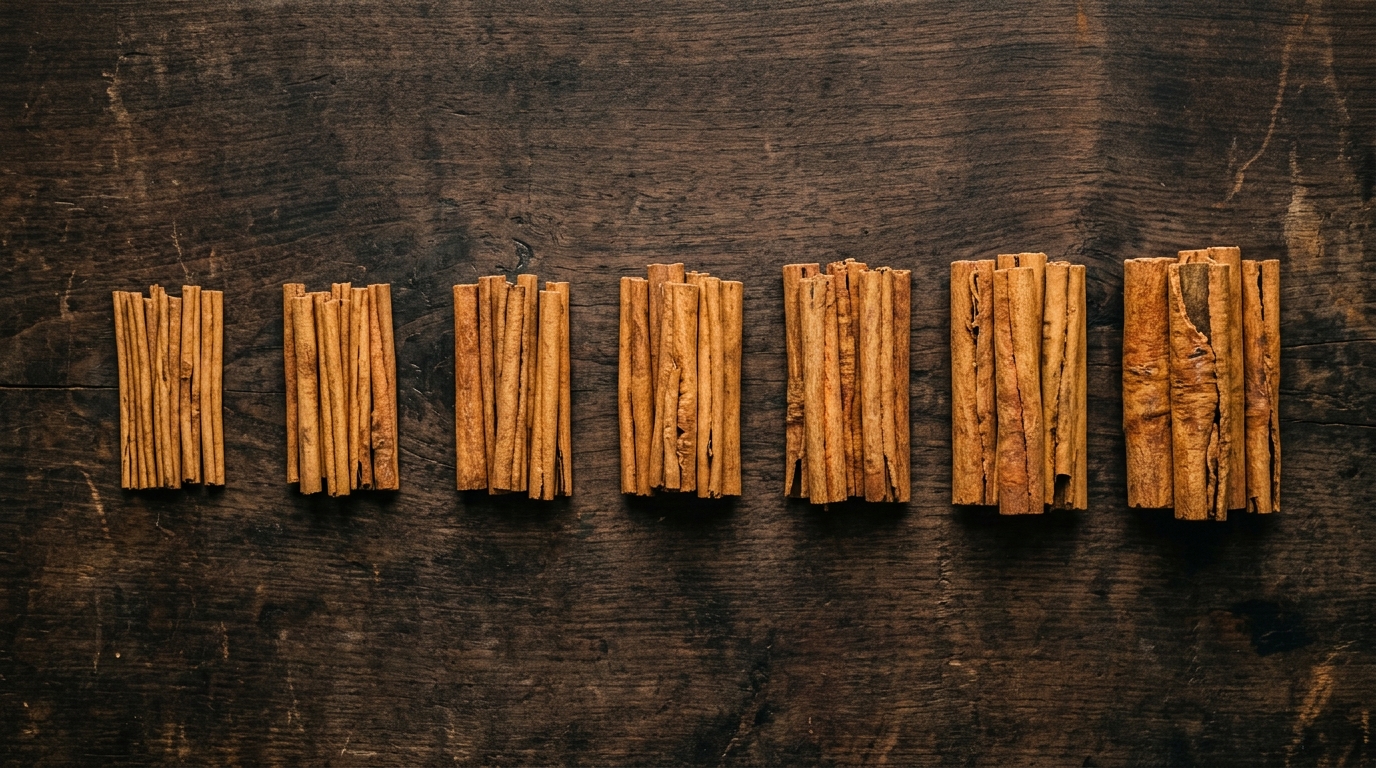
If you’ve shopped for Ceylon cinnamon sticks for more than a few minutes, you’ve probably run into a grade name you don’t recognize: Alba, C5, Hamburg, M4. These aren’t marketing terms. They come from an actual grading system used in Sri Lanka’s cinnamon trade, based mostly on the diameter of the rolled stick.
Here’s what they mean and how much they should actually influence your purchase.
What Grading Actually Measures
Ceylon cinnamon grading is based primarily on the diameter of the rolled quill, with thinner sticks generally graded higher than thicker ones.
A thinner stick means the bark used to make it was peeled more finely, which takes more skill and more raw bark to produce the same length of finished quill. That’s the main reason thinner grades cost more: they require more labor and material per stick, not because the cinnamon itself is a different plant or higher purity.
Grading assumes the product is already genuine Ceylon cinnamon. It says nothing about authenticity by itself, so confirming the sticks are genuine Ceylon cinnamon in the first place is a separate step that matters regardless of what grade is printed on the label.
Why Ceylon Cinnamon Is Graded at All
Grading exists because Ceylon cinnamon has been an export commodity for centuries, traded through established markets in Europe and Latin America that each historically preferred certain stick sizes. The grading names you see today, like Continental, Mexican, and Hamburg, are leftovers from those trade relationships rather than a description of quality created for today’s retail shoppers. Understanding that history explains why the names don’t sound like typical quality tiers such as “premium” or “standard.”
The Main Grades, From Thinnest to Thickest
Grades vary somewhat by exporter and market, but the general order, from thinnest and most prized to thickest and more everyday, looks roughly like this.
Alba
Alba is the thinnest and generally most expensive grade, made from the tenderest, youngest bark. Sticks are pale in color and very delicate, often rolled with multiple thin layers folded into each quill. Because the yield of Alba from a given amount of raw bark is lower than other grades, it commands a higher price.
Continental
Continental is a common mid-to-upper grade, thicker than Alba but still made with care for size consistency. It’s a popular choice for retail packaging aimed at home cooks, since it balances quality with a more accessible price than Alba.
Mexican
Mexican grade is named for its traditional export market rather than anything about the cinnamon itself. It tends to be slightly thicker than Continental and is commonly used in both retail and food manufacturing.
Hamburg
Hamburg grade, named after the German trading hub, includes several sub-grades (such as H1 and H2) and generally refers to a somewhat thicker, more robust stick suited to bulk buyers and manufacturers rather than individual retail jars.
M4 and Other Bulk Grades
Grades labeled with letters and numbers like M4, M5, or C5 typically refer to broken pieces, quillings, or lower-grade bark rather than long intact sticks. These are priced lower and are common in industrial use, such as cinnamon oil extraction or ground spice production, rather than being sold as whole sticks for home use.
Grading Isn’t Always Standardized the Same Way
Not every exporter or seller uses these exact names, and there’s no single global authority enforcing consistent labeling across all sellers. Sri Lanka’s official export standards do define grade specifications by measurement, but individual retailers sometimes simplify or relabel grades for their own markets, especially outside bulk or wholesale channels.
This means the same physical stick could be labeled slightly differently by two different sellers. If grade matters to your purchase, it helps to know how the label should present grade information and to ask the seller directly if it isn’t specified.
How Grade Affects Price
Because thinner grades require more raw bark and more skilled labor per finished stick, price generally increases as the grade gets finer. Alba is typically the most expensive, while bulk grades and broken pieces are the least expensive. This pricing pattern holds fairly consistently across sellers, even when the exact grade names used differ.
Is a Higher Grade Always Necessary?
Not for most home cooking. The flavor difference between Alba and Continental grade sticks, once used in cooking or tea, is smaller than the price difference suggests. Grade affects appearance, delicacy, and how the stick handles (thinner sticks can be more fragile and easier to grind), but the essential oils responsible for flavor are present across grades, since they all come from the same species and similar parts of the tree.
Higher grades matter more to buyers who care about presentation, such as gift sets or specialty retail, or to those grinding their own powder who want the ease of working with delicate, thin bark.
Which Grade Suits Different Buyers
- Everyday home cooking and tea: Continental or Mexican grade offers a practical balance of quality and price.
- Gifting, specialty retail, or presentation-focused use: Alba grade’s delicate appearance and reputation justify the higher price for buyers who value that.
- Bulk cooking, food service, or grinding your own powder in volume: Hamburg or similar mid-range bulk grades keep cost per use lower without a major flavor tradeoff.
- Extraction, manufacturing, or large-scale ground spice production: Lower grades like broken pieces or M-series grades are the practical, cost-effective choice.
What Matters Besides Grade
Grade is one factor among several. Freshness, storage conditions, and how recently the cinnamon was harvested and processed often affect flavor more noticeably than moving up or down one grade tier. A well-stored Continental-grade stick bought recently will usually outperform an Alba-grade stick that’s been sitting on a shelf for two years. Grade is worth understanding, but it shouldn’t be the only thing you check before buying.
FAQ
Is Alba the highest possible grade of Ceylon cinnamon? Alba is generally considered the finest widely available grade due to its thinness and delicate bark, though exact grading terminology can vary slightly between exporters.
Does a higher grade mean better flavor? Not dramatically. Grade mostly reflects stick thickness and appearance rather than flavor intensity. Freshness and storage typically influence flavor more than grade alone.
Why do some sellers not mention a grade at all? Grade information is more commonly disclosed by bulk or specialty sellers than by general retail brands, since many everyday shoppers aren’t looking for that level of detail. Its absence doesn’t necessarily indicate a lower-quality product.
Can powder be graded the same way as sticks? Not really. Grading is based on stick diameter, which no longer applies once the bark is ground. Powder quality is judged more by freshness, purity, and whether it’s genuine Ceylon cinnamon rather than by a grade name.
Is a lower grade lower quality or just a different size? Mostly a different size and yield rather than lower quality in the sense of being a worse plant or impure product. Lower grades are still genuine Ceylon cinnamon; they’re simply thicker sticks or broken pieces from the same processing.