
If you’ve ever picked up two jars labeled “cinnamon” and noticed the sticks inside look nothing alike, you’ve run into the Ceylon versus Cassia problem. Both are sold under the same name, both come from trees in the Cinnamomum genus, and both smell and taste like cinnamon. But they’re different species, grown in different countries, with different flavor profiles, different price points, and one meaningful chemical difference that affects how much of each you’d want to eat regularly.
Here’s what actually separates them, and where the differences matter enough to change how you shop or cook.
The Quick Answer
Ceylon cinnamon (Cinnamomum verum) and Cassia cinnamon (mainly Cinnamomum cassia, along with related species) differ in botanical origin, bark structure, color, flavor intensity, and coumarin content. Ceylon is lighter, milder, and more delicate, grown almost entirely in Sri Lanka. Cassia is darker, stronger, and cheaper, and it’s what most people are actually buying when a product simply says “cinnamon” without specifying a type.
Neither is “fake.” Cassia is a legitimate spice with its own long culinary history. The confusion comes from the fact that Western supermarkets rarely distinguish between them on the label, even though they behave differently in cooking and differ meaningfully in one safety-relevant compound.
Why They’re Both Called “Cinnamon”
This is worth explaining because it’s the root of most of the confusion. Cinnamon as a category includes several species in the genus Cinnamomum, all harvested for their aromatic inner bark. Historically, “cassia” and “cinnamon” were treated as related but separate spices, and in some parts of the world they still are. In much of the English-speaking retail market, though, they’ve been folded into a single “cinnamon” category, with Cassia as the default and Ceylon sold as a specialty product.
Ceylon cinnamon is often called “true cinnamon,” and that phrase has a specific origin rather than being a marketing invention. The species name verum is Latin for “true,” and it was assigned because Ceylon cinnamon, native to Sri Lanka, was the cinnamon documented in ancient trade and early botanical records before Cassia became widely available in Western markets. Sri Lanka still produces the large majority of the world’s Ceylon cinnamon supply.
Botanical and Origin Differences
| Factor | Ceylon Cinnamon | Cassia Cinnamon |
|---|---|---|
| Species | Cinnamomum verum (syn. Cinnamomum zeylanicum) | Cinnamomum cassia, plus related species like C. loureiroi (Saigon) and C. burmannii (Indonesian/Korintje) |
| Primary origin | Sri Lanka, with some production in southern India | China, Indonesia, and Vietnam |
| Family name | “True cinnamon” | Sometimes labeled Chinese, Saigon, or Indonesian cinnamon |
| Tree maturity harvested | Young shoots, thin inner bark | Thicker, more mature bark |
Cassia isn’t a single species. What gets sold as “Cassia” in stores can come from a few different Cinnamomum varieties depending on where it’s grown, which is part of why flavor and coumarin levels vary somewhat between Cassia products from different origins.
Appearance: What Ceylon and Cassia Look Like Side by Side
This is usually the fastest way to tell the two apart if you have whole sticks in front of you.
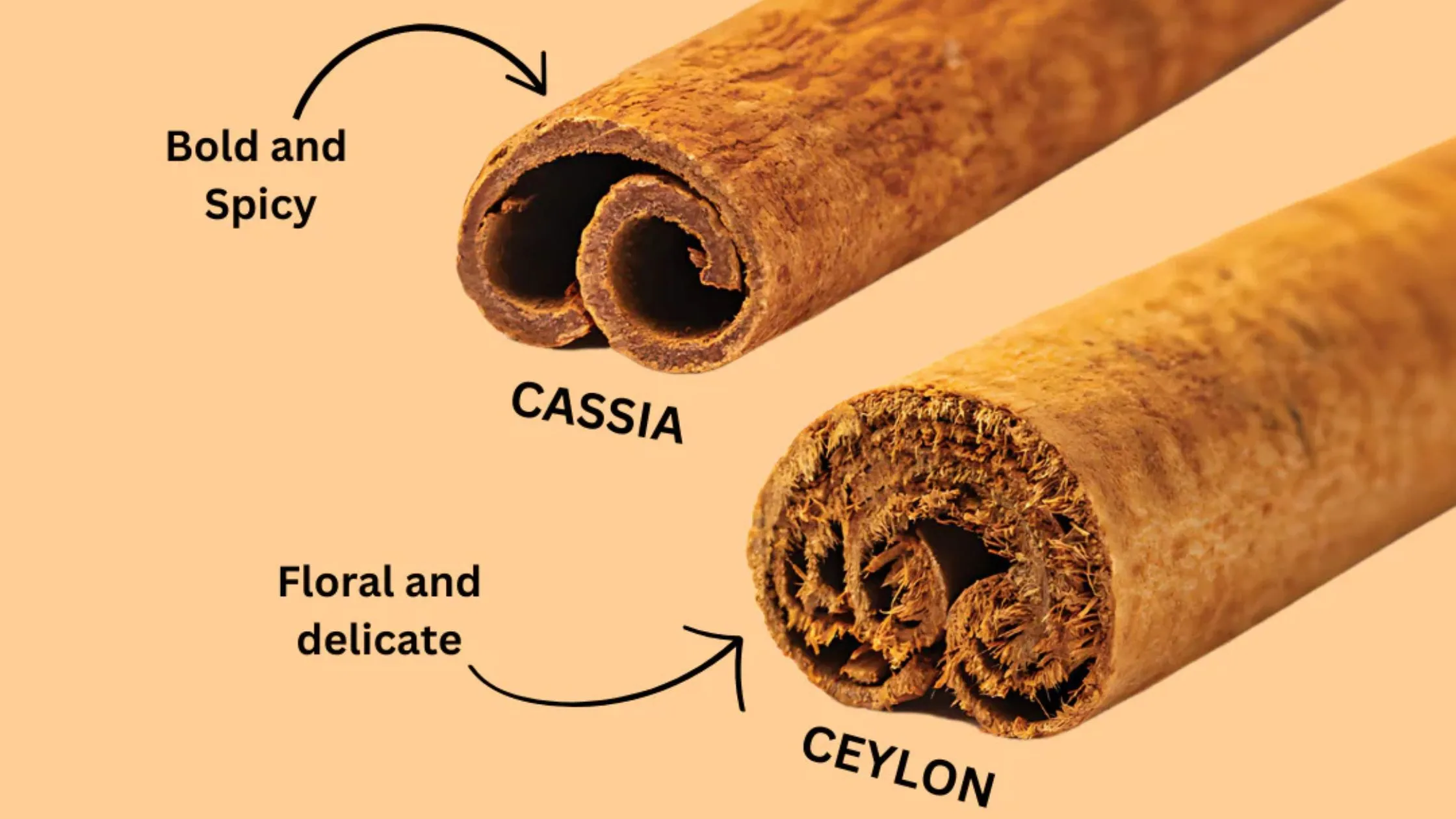
Ceylon cinnamon sticks are made by hand-peeling very thin layers of bark, often less than a millimeter thick, and rolling several of them together while still moist. The result is a quill built from multiple thin layers nested inside one another, similar to a tightly rolled scroll. Ceylon sticks are light tan to golden brown, soft enough to crumble or dent with a fingernail, and generally thinner than Cassia sticks.
Cassia sticks come from thicker, coarser bark rolled into one or two dense layers, forming a harder, more rigid tube. Cassia is reddish-brown to dark brown, doesn’t crumble easily, and snaps with a clean, woody break rather than flaking apart.
Once either one is ground into powder, this structural difference disappears, and color and aroma become the only remaining visual clues, neither of which is fully reliable on its own.
Flavor and Aroma
Flavor is where the two spices genuinely diverge, and it’s not just a matter of intensity.
Ceylon cinnamon has a mild, slightly sweet flavor with citrus and floral undertones, and a gentle warmth rather than a sharp bite. Cassia is bolder and more assertive, with a hot, peppery edge that’s closer to what most people picture when they think of “cinnamon” flavor, largely because Cassia is the version used in the vast majority of commercial cinnamon rolls, candies, and baked goods in the US and UK.
Neither flavor is objectively better. It depends on the dish:
- Ceylon tends to work well where you want cinnamon in the background: custards, delicate pastries, tea, and dishes where a strong spice note would overpower other flavors.
- Cassia holds its own in bold, spice-forward dishes: chai, mulled wine, gingerbread, and recipes where cinnamon is meant to be a dominant flavor.
If you’ve grown up eating Cassia-based baked goods, genuine Ceylon can initially taste unexpectedly mild, not weaker in a bad way, just different in character.
Coumarin: The Main Health-Relevant Difference
This is the one area where the difference between Ceylon and Cassia goes beyond taste and appearance.
Coumarin is a naturally occurring compound found in cinnamon bark. It’s not added; it’s simply part of the plant’s chemistry, and the amount varies significantly by species. Ceylon cinnamon contains very low levels of coumarin, generally cited as under roughly 200 mg/kg and often described as “trace” amounts. Cassia contains substantially more, with retail testing studies finding average levels commonly in the range of 2,000 to 7,000 mg/kg depending on the specific product and origin.
Coumarin is hepatotoxic at high intake levels, meaning it can affect the liver if consumed in excess over time. The European Food Safety Authority has set a tolerable daily intake of 0.1 mg of coumarin per kilogram of body weight per day. For context, Germany’s Federal Institute for Risk Assessment (BfR) has noted that for an average adult, this threshold can be reached with only a few grams of Cassia cinnamon consumed daily, which is a realistic amount for someone using cinnamon heavily in home cooking, tea, or supplements.
A few things worth being precise about here:
- This is not an acute poisoning risk from a normal serving of a cinnamon roll or a sprinkle on oatmeal.
- The concern applies mainly to regular, higher-volume use over time, such as daily cinnamon supplements, large amounts in home baking, or products marketed for blood sugar support that use undisclosed amounts of Cassia.
- The European Union has set coumarin limits specifically for cinnamon-containing food categories like baked goods, precisely because Cassia use in commercial products had been pushing coumarin intake higher than regulators consider ideal.
- Ceylon cinnamon’s low coumarin content means it doesn’t carry the same practical limit for regular use, which is the main reason it’s often recommended for people who use cinnamon daily or in larger quantities.
This is a real, measurable chemical difference, not a marketing exaggeration, but it’s also not a reason to treat occasional Cassia use in normal cooking as dangerous.
Price and Availability
Ceylon cinnamon typically costs meaningfully more than Cassia, often close to double or more per ounce, and the reason is production, not branding. Ceylon bark is hand-peeled in thin layers, a labor-intensive process concentrated in Sri Lanka, while Cassia is peeled in thicker sections at larger scale across China, Indonesia, and Vietnam, making it cheaper to produce and more widely available.
That price gap is also why Cassia dominates the mainstream spice aisle. Most grocery store “cinnamon,” ground or in sticks, is Cassia by default unless the packaging specifically states “Ceylon” and names Sri Lanka as the country of origin.
Which One Should You Use?
There’s no single right answer here. It depends on what you’re making and how often you use cinnamon.
| Use case | Better fit |
|---|---|
| Everyday sprinkle on toast, oatmeal, coffee | Either works; Ceylon if used daily in volume |
| Baking (cookies, cinnamon rolls, spice cakes) | Cassia, for a stronger, more traditional flavor |
| Delicate desserts, custards, rice pudding | Ceylon, for a subtler flavor that doesn’t dominate |
| Tea, infusions, mulled drinks | Both are used; Ceylon gives a lighter, more floral cup |
| Daily cinnamon supplement or high-volume home use | Ceylon, due to its much lower coumarin content |
| Savory dishes like curries, tagines, mole | Both appear in different regional traditions; Cassia is common in bolder spice blends, Ceylon in more delicate versions |
| Budget-conscious everyday cooking | Cassia, given the significant price difference |
If you only keep one jar of cinnamon in your kitchen and use it occasionally, the practical difference is smaller than marketing sometimes suggests. If you use cinnamon daily, in large amounts, or specifically for a supplement, the coumarin gap becomes a more relevant factor.
How to Tell Which One You Have
A few quick checks, useful whether you’re identifying cinnamon you already own or evaluating a product before buying:
- Check the label first. Look for the species name (Cinnamomum verum) and Sri Lanka as the country of origin. A package that just says “cinnamon” with no species or origin listed is almost always Cassia.
- Look at the stick structure. Multiple thin, nested layers mean Ceylon. One or two thick layers forming a solid, hollow tube mean Cassia.
- Check the color. Light tan to golden brown suggests Ceylon. Reddish-brown to dark brown suggests Cassia.
- Try to break it. Ceylon crumbles with light pressure. Cassia requires real force and snaps cleanly.
- Smell it. A sharp, hot, assertive cinnamon smell leans Cassia. A milder, sweeter, citrus-floral aroma leans Ceylon.
For ground cinnamon, none of these checks are fully reliable on their own, since grinding removes the structural clues and color can vary by grind. Label information and a trustworthy supplier matter more once cinnamon is powdered.
Frequently Asked Questions
What is the difference between Ceylon cinnamon and Cassia? They’re different species with different origins, appearance, flavor, and coumarin content. Ceylon (Cinnamomum verum) is milder, lighter in color, and grown mainly in Sri Lanka. Cassia is stronger, darker, cheaper, and more widely available, mainly grown in China, Indonesia, and Vietnam.
Is Ceylon cinnamon the same as Cassia? No. They’re related but botanically distinct species within the Cinnamomum genus, and they differ meaningfully in bark structure, flavor, and coumarin levels, even though both are commonly sold under the single label “cinnamon.”
Which is better, Ceylon cinnamon or Cassia? Neither is universally better. Ceylon offers a milder flavor and much lower coumarin content, making it a better fit for daily or high-volume use. Cassia offers a stronger, spicier flavor that many bakers prefer for classic cinnamon-forward recipes, at a lower price.
Does Ceylon cinnamon have less coumarin than Cassia? Yes, substantially less. Ceylon typically contains only trace levels of coumarin, while Cassia commonly contains coumarin in the thousands of mg/kg range, which is why food safety agencies in the EU have set specific coumarin limits for cinnamon-containing products.
Why is Ceylon cinnamon more expensive than Cassia? Ceylon bark is peeled by hand in very thin layers, a labor-intensive process concentrated in Sri Lanka. Cassia is peeled in thicker sections and produced at larger scale in China, Indonesia, and Vietnam, which keeps its cost significantly lower.
Is Cassia fake cinnamon? No. Cassia is a genuine, long-used spice in its own right, not a counterfeit of Ceylon. The issue isn’t that Cassia is fake, it’s that products labeled specifically as “Ceylon cinnamon” should actually contain Ceylon, and unlabeled “cinnamon” is worth assuming is Cassia unless stated otherwise.
Can you tell Ceylon cinnamon and Cassia apart once they’re ground into powder? Not reliably through appearance alone. Color and aroma offer some clues, Ceylon powder tends to be lighter and milder-smelling, but grinding removes the structural differences that make whole sticks easy to distinguish. Checking the label and buying from a supplier who states species and origin is more dependable for powder.