
Introduction
When people hear “Ceylon cinnamon,” they often think about quality, taste, or health benefits. But very few understand how it’s actually made.
The truth is, Ceylon cinnamon from Sri Lanka is not mass-produced like many other spices. It’s carefully harvested by hand, using skills passed down through generations.
If you want to understand what makes real cinnamon special, you have to start here—the harvesting process.
Quick Answer: How Ceylon Cinnamon Is Harvested
Ceylon cinnamon is harvested by:
- Cutting young cinnamon stems
- Removing the outer bark
- Carefully peeling the inner bark by hand
- Rolling it into thin layers (quills)
- Drying it naturally
Simple takeaway:
It’s a skilled, manual process—this is why Ceylon cinnamon is lighter, softer, and higher quality.
Where Ceylon Cinnamon Comes From
Ceylon cinnamon is mainly grown in Sri Lanka, especially in coastal regions like:
- Galle
- Matara
- Kalutara
The climate there—warm, humid, and tropical—is ideal for cinnamon trees.
These trees are not very tall. Farmers regularly cut them to keep them at a manageable height, which also helps produce better-quality bark.
The Harvesting Process (Step by Step)
This is where things get interesting. Unlike many crops, cinnamon harvesting is more like craftsmanship than farming.
1. Growing and Preparing the Tree
Cinnamon trees are grown for about 2–3 years before the first harvest.
Farmers:
- Cut the tree back regularly
- Allow multiple shoots to grow
- Focus on young, straight stems
Why young stems?
Because they produce softer, higher-quality bark.
2. Cutting the Stems
When the stems reach the right thickness (about finger-sized), they are cut close to the ground.
This process is called “coppicing.”
- New shoots grow back from the same plant
- The tree continues producing for many years
This makes cinnamon farming sustainable.
3. Scraping the Outer Bark
Once the stems are cut:
- The rough outer layer is scraped off
- This layer is not used
What remains is the smooth inner bark—the part that becomes cinnamon.
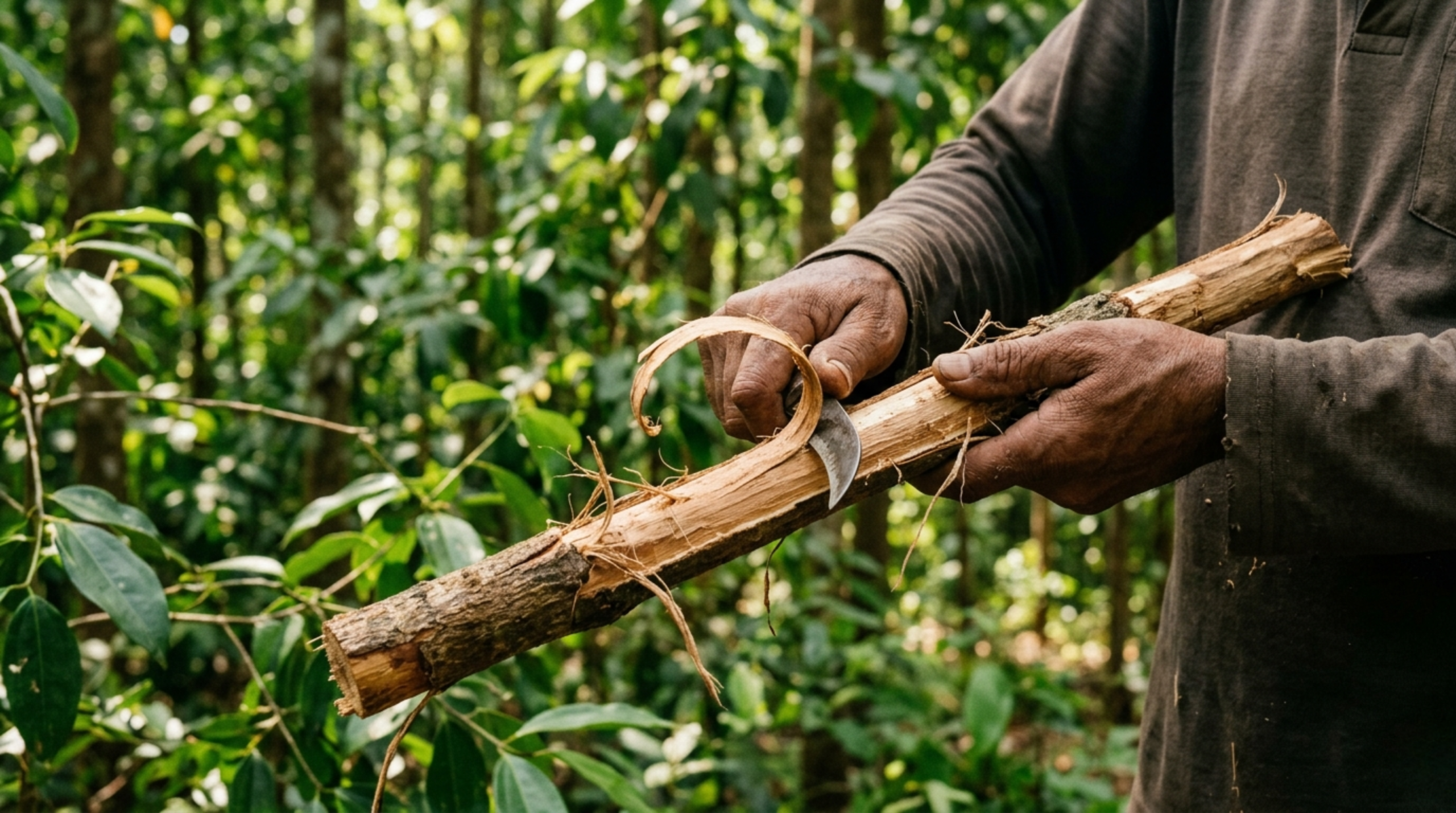
4. Peeling the Inner Bark
This step requires real skill.
Workers use a small knife to:
- Gently loosen the inner bark
- Peel it off in long strips
If done properly:
- The bark comes off cleanly
- The quality remains high
This is not something machines can easily replace.
5. Forming Cinnamon Quills
After peeling:
- The thin bark naturally curls
- Workers roll multiple layers together
This creates the familiar cinnamon sticks (quills).
Ceylon cinnamon is unique because:
- It has multiple thin layers
- Looks like a rolled cigar
This is very different from thick Cassia sticks.
6. Drying the Cinnamon
The quills are then:
- Dried in shade (not direct sunlight)
- Left for several days
During drying:
- The color changes to light brown
- The flavor develops
- The quills become firm but still delicate
7. Sorting and Grading
Once dried, cinnamon is sorted based on:
- Thickness
- Color
- Smoothness
- Appearance
Higher-grade cinnamon:
- Has thinner, more uniform layers
- Looks cleaner and lighter
This grading affects pricing and export quality.
Why This Process Matters
Understanding the harvesting process explains a lot:
1. Why Ceylon cinnamon is more expensive
- Labor-intensive
- Skilled manual work
- Slower production
2. Why it looks different
- Thin, layered structure
- Light color
- Soft texture
3. Why it tastes different
- Mild and smooth
- Not harsh or overpowering
Real Insight: It’s a Skilled Craft
In Sri Lanka, cinnamon peeling is a respected skill.
Workers (often called peelers):
- Train for years
- Learn precise techniques
- Work with speed and care
This is not factory work—it’s traditional craftsmanship.
That’s why high-quality Ceylon cinnamon is difficult to mass-produce.
Common Misconceptions
1. “Cinnamon is just tree bark”
True—but the process is what makes the difference.
2. “All cinnamon is made the same way”
Cassia cinnamon is processed differently and more industrially.
3. “Machines can do the same job”
Not really. The delicate peeling process is still mostly manual.
From Farm to Your Cup
By the time cinnamon reaches you:
- It has been grown for years
- Harvested by hand
- Carefully processed and dried
So when you add a cinnamon stick to tea, you’re not just using a spice—you’re using something that went through a detailed, human process.
How to Recognize Properly Harvested Ceylon Cinnamon
Look for:
- Thin, layered quills
- Light golden-brown color
- Smooth texture
- Easy to break
Avoid:
- Thick, hard sticks
- Dark, rough bark
These are usually signs of Cassia.
Conclusion
Ceylon cinnamon harvesting is simple to understand—but not easy to do.
It’s:
- Manual
- Skilled
- Time-consuming
And that’s exactly what gives it its value.
When you understand the process, you don’t just see cinnamon as a spice—you see the craft behind it.
FAQ: How Ceylon Cinnamon Is Harvested
1. How long does it take to harvest cinnamon?
Trees take about 2–3 years before the first harvest, but once established, they can be harvested regularly.
2. Is cinnamon harvesting sustainable?
Yes. The trees regrow after cutting, making it a renewable crop.
3. Why is Ceylon cinnamon softer than Cassia?
Because it comes from younger stems and is peeled into thin layers.
4. Is cinnamon harvested all year round?
Yes, but peak harvesting seasons depend on rainfall and climate conditions in Sri Lanka.
5. Why is Ceylon cinnamon more expensive?
Because of the manual labor, skill involved, and limited growing regions.